| Community art | |||||||
Punttu familyPeggy Nappangarti Jones and Flora Holt Naljarri have both exhibited outside Tennant Creek, with Nappangarti building a strong national, and increasingly, international reputation. Flora had her first solo exhibition in Melbourne in 2003. Both artists use strong colours and singular graphic shapes of bush tuckers and animals they are familiar with from their country. Nappangarti’s portrait is of herself as a young woman, looking directly out of the picture at the viewer. Nappangarti often talks of her youth, of walking through country between stations and reserves, collecting bush tucker and learning about country from her mother and aunties. Flora grew up on Brunette Downs, one of the most famous of the large Northern Territory cattle stations. Flora worked on the station, but also learned ceremony and dance from her elders, which she now passes onto a younger generation. Flora’s work is almost psychedelic, with swirling colour fields surrounding single images of plants or animals. Her portrait uses a colour palette typical of her paintings – luminous oranges, pinks and lime greens. Both Flora and Nappangarti, now in their fifties have strong cultural knowledge and punttu is the foundation of that knowledge. All of the prints in the series, in one way or another, give us a picture of life in Tennant Creek today from a Warumungu perspective. The imagery spans a lifetime of experience from the late 1950s to the present day. The ages of the participating artists range from twelve to fifty-six, a very broad sweep. And although so broad in the experience of life, all of the artists have a relationship to Tennant Creek or patta (hard rock country). Many artists grew up on communities alongside cattle stations, or on government reserves, but have moved to this town since the curfew for Aboriginal people was lifted in the late 1960s. From those early days of living in fringe camps around Tennant Creek, the Aboriginal community has now become a major economic force in the Barkly region, with strong representative organizations and a desire to show a non-Indigenous audience an active culture that embraces both modernity and traditional aspects of Warumungu life. Alison Alder |
|||||||
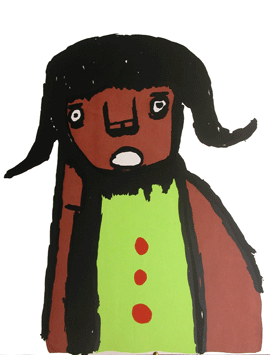
Peggy Nappangarti Jones |
|||||||
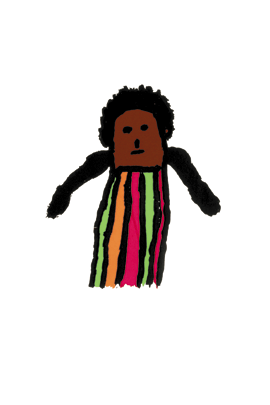
Flora Holt Naljarri |
|||||||